Population as control
At N=100,000 the facility knows what normal looks like. A bad lot bends thousands of curves at once and points at itself. Nobody reserves material to prove the experiment happened.
biological datacenter program
by doing what is considered impossible: scaling biology
Biology is a low-resolution science because every datapoint has a price; we are engineering that price to near zero.
the economics
Every one of them grows with the number of animals. Fix five and the sixth still sets the price.
the argument
At N=100,000 the facility knows what normal looks like. A bad lot bends thousands of curves at once and points at itself. Nobody reserves material to prove the experiment happened.
Lab robots don't scale either. High-finesse machines cost as much as the people they replace; cost still linear in N. Handling here is primitive so it can scale: gravity, air, the mouse. If a step needs a pipette, the step gets redesigned.
Gravity, cold, optics, radar, gas sensing, mass spectrometry: instruments whose per-sample cost is fixed, not linear. Use a reagent only to teach those instruments what to look for.
one mouse · box · village · cryo · mass spec
one mouse · one instrument
digital twin · target-state model · streaming
holy grail
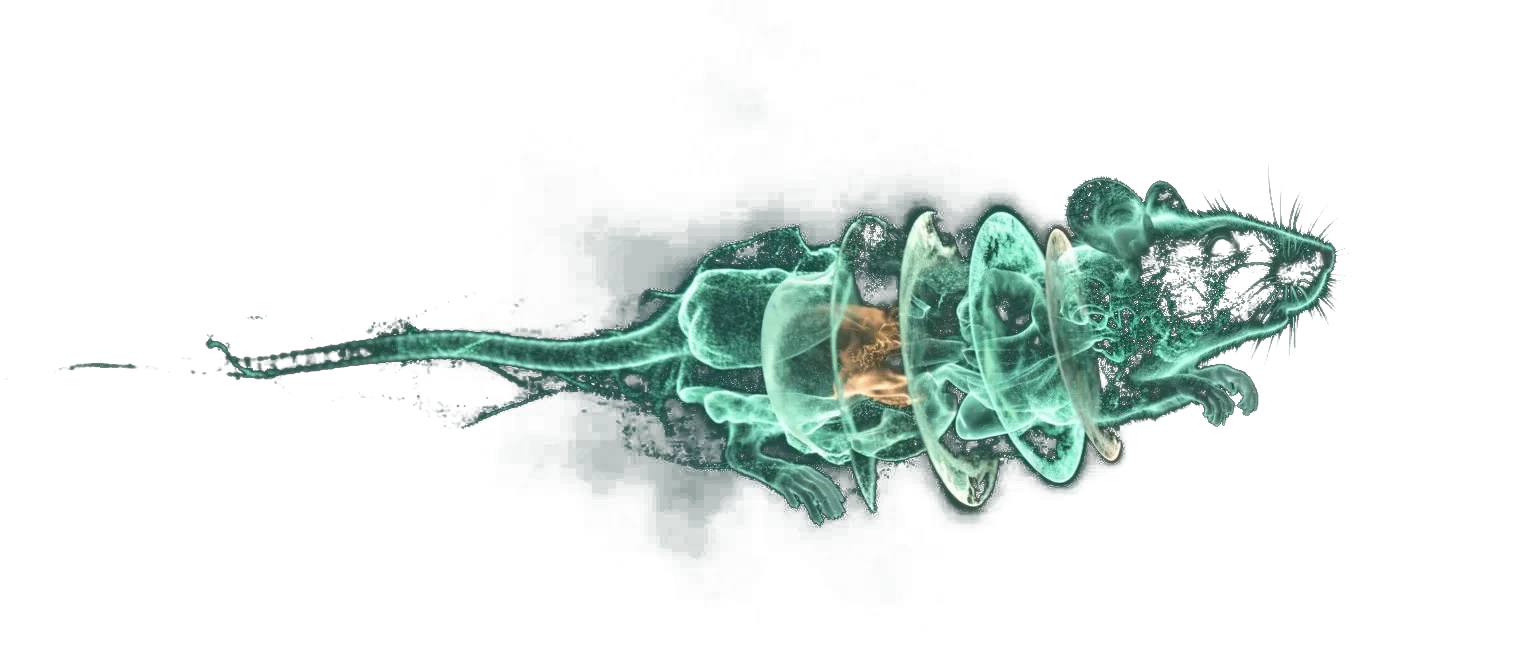
Watch what a compound does to a whole living organism: every tissue, every day, every dose, from the moment of dosing. At n=8 a one-in-10,000 toxicity is invisible and variance is noise to be averaged away. At n=100,000 variance is the signal: which animals react differently, and when, and where, is what predicts which humans will. That is how you get probabilistic biology.
the ask
A working prototype and a live pilot. The Box built in Boston, full sensor stack; a first live-animal pilot in Japan; telemetry read against classical readouts. Kill if it costs like a lab robot, shows no predictive signal, or the animal does not thrive.
500 Boxes, one mouse each, 18 months. Prove the unit works and the cost curve bends. Kill if it does not.
10,000 Boxes, first cohort; first pharma datasets.
First hall: shell, LN₂ tanks, mass-spec floor, ~250,000 Boxes. The rest are added like racks, with ~$540M reaching one million, funded from a mix of cohort revenue, credit and equity. A building and an instrument fleet against contracted demand should not be priced as venture risk. Unlocked only once M2 has produced the economics and the first data.